Mon-Fri 07:00 AM - 05:00 PM
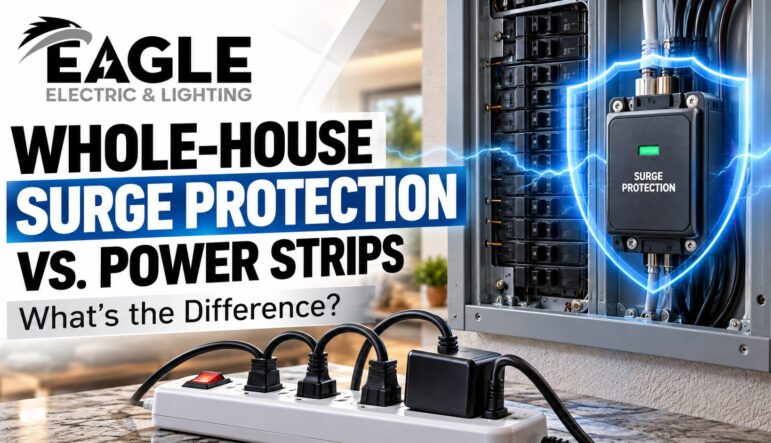
When it comes to protecting your home’s electrical system, choosing between whole-house surge protection and plug-in power strips can make a significant difference in how well your valuable electronics and appliances are protected. For homeowners in Boise, Eagle, Star, Meridian, Middleton, Caldwell, Emmett, and Nampa, understanding these two options is an important step toward reducing the risk of electrical damage. Although both solutions can help protect electronic equipment, they work differently, cover different parts of your home, and offer different levels of protection. In this guide, we explain how whole-house surge protection compares with power strips, when each option makes sense, and how to choose the right combination for your Idaho home.
Surge protection helps defend electrical equipment against sudden increases in voltage that can damage sensitive electronic components. A power surge may last only a fraction of a second, but it can disrupt equipment operation, shorten the life of appliances, or cause immediate failure. These events can originate from utility switching, lightning-related electrical disturbances, or changes in electrical demand when equipment starts and stops.
Many homeowners associate electrical surges exclusively with thunderstorms. However, surges can also originate inside a home when equipment such as air conditioners, refrigerators, pumps, and other motor-driven appliances switches on or off. Repeated smaller surges may gradually stress sensitive electronics even when no obvious damage occurs immediately.
Homes throughout the Treasure Valley rely on a combination of heating and cooling equipment, kitchen appliances, entertainment systems, computers, smart-home devices, and increasingly, electric vehicle charging equipment. A surge can potentially affect several connected devices, depending on its source, severity, and the available protection. Replacing damaged electronics or repairing affected equipment can be inconvenient and expensive, particularly when multiple items are involved.
In Boise neighborhoods such as the North End, the Bench, and Harris Ranch, homeowners may have different electrical layouts, equipment configurations, and renovation histories. Eagle homeowners near Eagle Island State Park, growing residential areas of Meridian, and properties around Star and Middleton may also have different electrical service arrangements. The most appropriate protection depends on the home’s electrical system, connected equipment, and exposure to potential surge events rather than its neighborhood alone.
Surge protection is particularly useful for electronics containing sensitive circuit boards and microprocessors. Consider the equipment you would find difficult or expensive to replace if an electrical disturbance caused damage.
Not every device has the same level of vulnerability, and not every surge will cause damage. The goal is to establish appropriate layers of protection rather than assume that one device can eliminate every electrical risk.
Whole-house surge protection uses a surge protective device, commonly called an SPD, installed at an appropriate point in the home’s electrical system. Depending on the equipment and installation design, it may be installed at the main electrical panel or another suitable location. The device limits transient overvoltage by diverting or otherwise managing surge energy according to its design, helping reduce the amount of surge voltage that reaches connected electrical equipment.
Unlike a plug-in surge protector, a properly selected whole-house device can provide protection across the home’s electrical circuits. That broader coverage can benefit equipment that is permanently connected to the electrical system, including certain heating and cooling components, built-in appliances, lighting controls, and other devices that cannot conveniently be plugged into a surge-protecting power strip.
A whole-house SPD monitors electrical conditions and responds when a transient voltage exceeds its operating threshold. Its protective components limit the transient and direct surge current along the intended protective path, reducing the voltage stress experienced by connected equipment. The precise performance depends on the device’s ratings, installation, grounding and bonding conditions, and the characteristics of the surge.
Installation should be performed by a qualified electrician who can evaluate the panel, select a compatible device, and follow applicable electrical codes and manufacturer instructions. Proper conductor routing, connection quality, grounding and bonding, and installation location matter. Simply adding a device without checking the surrounding electrical system does not guarantee effective protection.
Whole-house surge protection is particularly worth considering when a home contains expensive appliances, connected technology, a home office, or equipment with electronic controls. Homeowners in Boise, Eagle, Meridian, and other Treasure Valley communities can benefit from having their electrical panel and protective requirements evaluated before selecting a device.
A surge protector power strip is a plug-in device that provides multiple outlets and incorporates components designed to limit certain voltage surges. It is commonly used for televisions, computers, routers, gaming systems, and other equipment located near a wall outlet. When a surge occurs, the device helps limit transient voltage reaching the equipment connected to it, subject to its ratings and condition.
However, a conventional power strip and a surge protector are not necessarily the same thing. A basic power strip simply provides additional outlets and may offer no surge protection whatsoever. Consumers should look for a clearly identified surge protective function, relevant electrical ratings, and appropriate safety certification rather than assume that every multi-outlet strip protects connected equipment.
Most consumer surge protectors use components that respond to transient voltage and help limit the voltage passed to connected equipment. Some models also include indicator lights, audible alerts, automatic shutdown features, or other functions. These features vary by product, so buyers should review the manufacturer’s documentation and understand what the indicators actually mean.
Point-of-use protection is useful because it places a protective device close to the electronics being protected. Nevertheless, it primarily protects equipment connected through that device. It does not provide the same broad coverage as a properly installed whole-house SPD, and it may not protect permanently wired appliances or equipment connected through other circuits.
For homeowners in Caldwell, Nampa, Emmett, Star, and Middleton, a plug-in surge protector can be a sensible choice for a computer, television, or home office. The important distinction is that localized protection should not be mistaken for comprehensive protection of the home’s electrical system.
Both solutions serve a useful purpose, but they differ in coverage, installation, maintenance, and the equipment they can protect. Understanding these distinctions makes it easier to select the right arrangement for your household.
A whole-house SPD is designed to protect connected equipment across multiple circuits, subject to its installation and performance characteristics. It can help reduce surge exposure for certain hardwired appliances, lighting systems, and electronics throughout the home. A plug-in surge protector primarily protects devices connected through its outlets.
For example, a homeowner in Boise may use a panel-mounted SPD to establish broad protection and then use a listed plug-in surge protector for a home office computer, monitor, and router. This layered approach addresses both the home’s wider electrical system and the needs of sensitive equipment at individual outlets.
A whole-house surge protector generally requires professional installation and an assessment of the electrical panel. The total cost depends on the selected device, panel configuration, installation complexity, and any additional work required to meet applicable electrical requirements. Homes with older panels or unusual electrical arrangements may need further evaluation before installation.
A plug-in surge protector usually costs less upfront and is easier to install. However, the purchase price alone does not tell the whole story: a plug-in unit does not replace whole-house coverage, and multiple strips may still leave permanently connected equipment without equivalent protection. Compare the cost with the equipment being protected and the level of coverage you need.
Surge protective devices have technical ratings that help describe their capabilities. When comparing whole-house SPDs, ask about their surge-current rating, voltage protection characteristics, compatibility with the electrical system, applicable listing, and manufacturer guidance. For plug-in models, check the joule rating where provided, clamping or voltage protection information, safety certification, and whether the manufacturer offers a protection-status indicator.
No single rating guarantees that a device will protect every appliance under every condition. Protective components can deteriorate, and a status light may not communicate every possible failure. Follow the manufacturer’s replacement instructions and replace a device when it indicates that protection has been lost, following a significant event when directed, or when it is damaged or no longer functioning as intended.
Whole-house surge protection and plug-in surge protectors can reduce the risk of damage from many transient events, but neither makes a home immune to lightning or severe electrical disturbances. A direct lightning strike can produce destructive energy that ordinary residential surge protection is not designed to withstand completely.
If severe weather is approaching and it is safe to do so, disconnect sensitive equipment from power sources before the event. Do not touch plugs, cables, or electrical equipment during an active lightning event or when conditions make doing so unsafe. Surge protection should complement, not replace, appropriate electrical safety practices.
Homes across Boise, Eagle, Star, Meridian, Middleton, Caldwell, Emmett, and Nampa vary in age, electrical configuration, appliance usage, and technology needs. A recently built home with modern electronics may have different protection priorities from an older property with a renovated kitchen, an upgraded heating system, or a home office added after the original electrical installation.
Local conditions should be considered carefully without assuming that every neighborhood experiences the same surge frequency or electrical risk. The practical question is how your home’s electrical system is configured and which devices would be most costly or disruptive to replace if they were damaged.
Some Boise properties have undergone electrical updates over time, while others retain portions of older electrical systems. Homeowners in the North End, the Bench, or near downtown should consider whether renovations have changed the electrical load, whether the panel is suitable for modern equipment, and whether sensitive devices have appropriate point-of-use protection.
A home office with computers, networking equipment, and external displays may benefit from a quality plug-in surge protector. If the household also relies on electronic appliance controls, heating and cooling equipment, and connected home systems, a qualified electrician can assess whether whole-house protection would provide a useful additional layer.
Newer or recently renovated homes around Eagle Island State Park, residential Meridian, and Star may include smart thermostats, automated lighting, security equipment, multiple entertainment devices, and other connected systems. These features can make daily life more convenient, but they also increase the amount of electronics a household depends on.
Homeowners should identify which devices are permanently connected and which plug into wall outlets. Whole-house protection may help reduce surge exposure across the electrical system, while appropriately rated point-of-use devices can provide additional protection for computers, routers, televisions, and other sensitive electronics.
In Middleton, Caldwell, Emmett, and Nampa, the right protection plan depends on the individual property rather than a citywide assumption. Homes with well pumps, irrigation controls, detached workshops, garages, outbuildings, or other specialized equipment may need a more detailed review of their electrical layout and the protective measures appropriate for each system.
Heating and cooling equipment, refrigerators, freezers, irrigation controllers, and other appliances with electronic components are worth including in an electrical protection assessment. A licensed electrician can determine which devices may benefit from whole-house protection, whether additional protection is appropriate for particular circuits, and whether the existing grounding and bonding arrangements require attention.
For many households, the most practical solution is not choosing one device and ignoring the other. Whole-house protection can establish a broad layer of defense, while plug-in surge protectors can provide additional protection at selected locations. The appropriate combination depends on your electrical system, the devices you use, and the manufacturer’s installation and compatibility requirements.
Before purchasing a product, confirm that it is genuinely designed for surge protection and is appropriately certified for its intended use. Review its electrical ratings, connected-equipment limitations, warranty conditions, and instructions for replacement. Avoid daisy-chaining power strips or exceeding the outlet and circuit ratings, and never treat a surge protector as a substitute for adequate circuit capacity.
For whole-house installations, have a qualified electrician confirm that the device is compatible with the panel and electrical service. The electrician should also evaluate grounding and bonding, installation location, conductor routing, and applicable code requirements. These details are important because even a high-quality SPD cannot perform as intended if it is improperly selected or installed.
Whole-house surge protection provides broader coverage across the home’s electrical circuits, while a plug-in surge protector generally protects equipment connected through its outlets. Neither option completely eliminates surge risk. For many households, combining an appropriately installed whole-house SPD with quality point-of-use protection offers a more comprehensive approach than relying on either solution alone.
No. A basic power strip provides additional outlets but may not contain surge-protective components. Look for a product explicitly identified as a surge protector, review its ratings and safety certification, and follow the manufacturer’s instructions. Do not assume that a strip offers surge protection simply because it has multiple outlets or a power switch.
A properly selected and installed whole-house SPD can help reduce surge exposure for refrigerators, air conditioners, and other connected equipment, depending on the electrical configuration and the device’s capabilities. It cannot guarantee that these appliances will never experience electrical damage. An electrician can assess whether the installation provides appropriate protection and whether additional equipment-specific measures are warranted.
Yes, a suitable plug-in surge protector can provide an additional layer of protection for sensitive equipment such as computers, televisions, and networking devices. Whole-house protection and point-of-use protection address different parts of the electrical system. Choose devices that meet the equipment manufacturer’s requirements, and remember that layered protection reduces risk rather than guaranteeing complete immunity from surges.
There is no universal replacement interval for every model. Follow the manufacturer’s service-life guidance, inspect the device periodically, and replace it if its protection indicator signals a problem, if it is damaged, or when the manufacturer recommends replacement after a significant surge. A power strip that still supplies electricity is not necessarily proof that its surge-protection components remain effective.
No residential surge protector can guarantee protection against a direct lightning strike. Whole-house SPDs and plug-in surge protectors can help manage many transient overvoltage events, but severe lightning-related surges can exceed their capabilities. Appropriate lightning safety practices, suitable electrical installation, and disconnecting sensitive equipment when safe and practical remain important.
Whole-house surge protection should be installed by a qualified electrician familiar with residential electrical panels, applicable codes, and surge protective devices. Professional evaluation helps confirm that the device is compatible with the service, properly connected, and installed according to manufacturer requirements. Homeowners in Eagle, Meridian, Boise, and surrounding communities should request an assessment based on their actual electrical system and equipment needs.
Whole-house surge protection and plug-in surge protector power strips serve different but complementary purposes. A properly installed whole-house SPD can help protect equipment across multiple circuits, while a quality plug-in unit provides localized protection for electronics that are especially important to your household. Understanding the difference helps you make a more informed decision about protecting appliances, computers, home entertainment systems, and other connected equipment.
Whether you live in Boise, Eagle, Star, Meridian, Middleton, Caldwell, Emmett, or Nampa, start by reviewing the equipment in your home, checking the condition of existing surge protectors, and determining whether your electrical panel has appropriate protection. Avoid assuming that a single device can prevent every type of electrical damage, and seek professional guidance when you are unsure about installation or compatibility.
For guidance on residential electrical protection and related electrical services, visit Surge Protection resources from Eagle Electric & Lighting. To discuss whole-house surge protection for your property, request an evaluation of your electrical panel, connected equipment, and potential protection needs. A properly planned approach can help reduce electrical risks and give you greater confidence in the equipment your home depends on every day.