Mon-Fri 07:00 AM - 05:00 PM
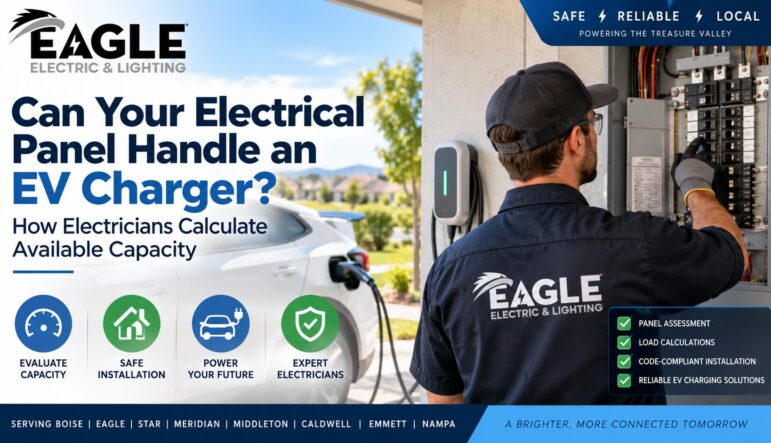
If you are planning Eagle EV Charger Installation, one of the first questions to answer is not which charger looks best—it is whether your home’s electrical service has enough capacity for it. A Level 2 charger can add a substantial electrical load, especially when it operates for several hours overnight. For homeowners in Eagle, Boise, Star, Meridian, Middleton, Caldwell, Emmett, and Nampa, an electrician should evaluate the existing service, panel, wiring, and other major loads before deciding whether a charger can be added safely.
A Level 2 EV charger typically operates from a 240-volt circuit and may draw substantial current for an extended period. The U.S. Department of Energy explains that Level 2 home charging uses 240 volts, while Level 1 charging uses a standard 120-volt outlet. The actual charging rate depends on the EV, charging equipment, circuit, and installation.
That continuous nature matters. An electric dryer or range may run intermittently, but an EV can charge for hours after you go to bed. An electrician therefore cannot simply look at empty breaker spaces and assume the panel has enough capacity. The complete electrical service and expected load have to be evaluated.
For example, a 32-amp Level 2 charger operating at 240 volts uses about 7.7 kW while charging. A 40-amp charger uses about 9.6 kW, while a 48-amp charger uses approximately 11.5 kW. These figures show why a home that has never experienced electrical problems can still need a professional load evaluation before a high-output EV charger is added.
The first step is identifying the home’s electrical service rating. The main service may be 100, 125, 150, 200, or another rating, but the number printed on the main disconnect is only the starting point. An electrician also examines the service conductors, meter equipment, panel condition, available breaker spaces, feeder arrangements, and how existing electrical loads are distributed.
The condition and configuration of the panel are important as well. A panel may have open breaker spaces but still have limited electrical capacity. Conversely, a panel that appears crowded does not automatically mean an EV charger cannot be installed. Capacity and physical space are separate questions that both need to be addressed.
Next comes a load calculation. Rather than simply adding every breaker rating together, an electrician considers the calculated demand of the home’s major electrical loads. This can include heating and cooling equipment, electric water heating, cooking equipment, clothes dryers, hot tubs, well pumps, workshops, pool equipment, and other significant electrical loads.
The EV charger is then incorporated into the calculation using applicable electrical code requirements and the charger’s installation instructions. EV charging is generally treated as a continuous load, which affects how the branch circuit and equipment are sized. This is one reason a charger advertised as “40 amps” may require a larger-rated branch circuit and breaker rather than simply matching the breaker to 40 amps.
A 200-amp service is common in newer homes, but it does not mean there is unlimited capacity available for additional equipment. Imagine a home with electric resistance heat, an electric water heater, an electric range, a clothes dryer, a hot tub, and a large air-conditioning system. The calculated demand can be considerably higher than a homeowner might expect from simply looking at the main breaker.
Conversely, a home with a 100-amp or 125-amp service may sometimes be able to accommodate EV charging depending on its calculated load, charger output, and existing equipment. The correct answer comes from the load calculation—not from a blanket rule saying every EV requires a panel upgrade.
This distinction is particularly important in established areas around Boise and Eagle, where homes can have different electrical systems based on construction era, remodeling history, previous electrical upgrades, and appliance choices. A house near Downtown Eagle, Eagle Island, Banbury, Two Rivers, or older parts of Boise may have a very different electrical configuration from a recently constructed home.
An electrician first identifies the home’s service rating and evaluates the equipment supplying the property. This establishes the basic ceiling for the electrical service, but it does not by itself determine how much capacity remains for an EV charger.
The electrician reviews the home’s significant electrical loads, including heating and cooling systems, water heaters, ranges, dryers, pumps, hot tubs, workshops, and other equipment. The calculation accounts for applicable demand factors rather than simply adding every circuit breaker rating together.
The proposed EVSE rating is then incorporated into the calculation. A 32-amp charger, 40-amp charger, and 48-amp charger create different electrical demands. The electrician also verifies the vehicle manufacturer’s requirements, EVSE installation instructions, circuit conductors, overcurrent protection, and applicable electrical code provisions.
If sufficient capacity exists, the charger may be installed using the existing service. If the calculated demand is too high, possible solutions can include reducing the charger’s charging current, installing appropriate load-management equipment, upgrading the electrical panel, or increasing the electrical service.
The objective is not simply to make the charger turn on. The objective is to create an installation that can operate safely under expected conditions without overloading the service, panel, feeder, branch circuit, or other electrical equipment.
Homes throughout the Treasure Valley have different electrical characteristics, and the practical installation can vary significantly from one property to another. In Eagle, areas around Downtown Eagle, Eagle Island, Banbury, Two Rivers, and the Greenbelt include a mixture of established and newer construction. In Boise, neighborhoods such as the North End, Harris Ranch, Southeast Boise, Barber Valley, and West Boise likewise contain homes with different electrical configurations.
For homeowners searching for Eagle EV Charger Installation in Boise or EV charger installation near Eagle Island and Downtown Eagle, the home’s electrical service should be evaluated rather than assuming that a particular charger will work simply because another nearby property has one.
In Star, Meridian, Middleton, Caldwell, Emmett, and Nampa, the distance between the electrical panel and the preferred parking location can also affect the project. An attached garage may allow a relatively straightforward wiring route, while a detached garage, long driveway, or exterior charger location can require additional conduit, trenching, weather-rated equipment, or a longer feeder.
Local permitting is another practical consideration. The City of Eagle, for example, maintains an electrical permit and inspection process. Homeowners should confirm the requirements that apply to their specific jurisdiction before installation rather than assuming the rules are identical across Eagle, Boise, Meridian, Star, Middleton, Caldwell, Emmett, and Nampa.
An EV charger is only one part of a home’s electrical demand. In Treasure Valley homes, electricians may need to account for equipment such as electric furnaces or heat pumps, central air-conditioning systems, electric water heaters, electric ranges, clothes dryers, hot tubs, and workshop equipment.
Heating and cooling can be especially important because electrical demand may be significant during the same seasons when homeowners are using their vehicles regularly. A heat pump, electric furnace, or large air-conditioning system can materially affect the home’s calculated load.
An electric water heater, range, and clothes dryer can also contribute substantial electrical demand. Their individual circuit breakers should not simply be added together to determine available capacity, but their loads still need to be considered as part of the applicable calculation.
Homes with hot tubs, pools, irrigation pumps, woodworking equipment, welders, compressors, or other high-demand equipment may require additional attention. These loads can make the difference between installing a higher-output Level 2 charger and selecting a lower charging rate or load-management strategy.
This is why homeowners should not compare their proposed EV charger only with the largest breaker in the panel. Breaker size, service size, calculated demand, conductor capacity, equipment ratings, and applicable requirements all work together.
A capacity assessment may reveal that the existing service can support the charger, that a lower-output charger is more appropriate, or that an electrical upgrade should be considered. An electrician may also discover a panel with limited physical space, obsolete equipment, damaged components, or other conditions that should be addressed before a new high-load circuit is added.
Some homeowners assume that installing a larger breaker will solve the problem. It will not. A breaker must be properly matched to the conductors, equipment, circuit design, and permitted load. Increasing breaker size without verifying the entire circuit can create a serious safety hazard.
If the calculated load exceeds available capacity, possible solutions can include a service upgrade, panel replacement, load-management equipment, a lower charging current, or another code-compliant design. The appropriate option depends on the home’s electrical system and the EV owner’s charging requirements.
Not every EV owner needs the fastest possible home charging. Level 1 charging uses a standard 120-volt connection and can work for drivers with modest daily mileage and sufficient overnight parking time. Level 2 charging uses 240 volts and can provide substantially faster charging, which can be useful for longer commutes, larger battery vehicles, or households that need more energy added overnight.
The U.S. Department of Energy reports that many EV drivers charge at home overnight and that Level 2 equipment can be installed in homes when the electrical system has adequate capacity. ENERGY STAR also recommends checking a home’s electrical capacity before installing a Level 2 charger.
For Idaho Power customers, charging schedules can also be worth considering. Idaho Power promotes a Time of Day pricing option with lower prices during certain nighttime periods. That can make overnight charging an attractive part of an EV ownership routine, although homeowners should confirm current utility rates and eligibility directly with the utility.
A good EV charger project begins with the home, not the charger box. Before purchasing equipment, homeowners should identify the vehicle’s maximum AC charging capability, determine how much daily range they need to replace, choose a practical parking location, and have the electrical service evaluated.
For Eagle EV Charger Installation in neighborhoods such as Banbury, Two Rivers, Eagle Island, and Downtown Eagle, the installation design may vary based on the home’s construction, garage configuration, panel location, and distance to the parking space. The same principle applies to homeowners searching for EV charger installation in Boise, Star, Meridian, Middleton, Caldwell, Emmett, or Nampa.
A charger mounted close to the main panel may have a different installation path from one installed in a detached garage or on the opposite side of the property. The electrician should determine the appropriate conductor size, overcurrent protection, conduit requirements, equipment location, and installation method for the specific property.
Eagle Electric and Lighting provides residential and commercial electrical services throughout the Treasure Valley. Homeowners can learn more about Eagle EV Charger Installation and discuss their home’s electrical requirements before selecting charging equipment.
Sometimes, but it cannot be determined from the service rating alone. An electrician needs to calculate the home’s existing demand and compare it with the proposed EV charging load. The result may support a lower-current Level 2 charger, another charging strategy, or an electrical upgrade.
Not necessarily. A 48-amp EV charging load at 240 volts is approximately 11.5 kW, and the service must be evaluated with the home’s other calculated loads. Electric heating, air conditioning, water heating, cooking equipment, dryers, hot tubs, and other loads can materially affect the result.
Electricians review the service rating, service conductors, panel equipment, existing circuits, major appliances, heating and cooling loads, and other relevant demand. They then apply applicable electrical code requirements and the EVSE manufacturer’s installation requirements to determine whether the proposed charger can be supplied safely.
Not always. Some homes can accommodate a Level 2 charger with the existing service, while others may need load management, a lower charging rate, a panel change, or a service upgrade. The answer should come from an electrical evaluation and load calculation rather than an assumption based only on the panel’s amp rating.
The required breaker depends on the EVSE’s maximum continuous current, installation instructions, conductor sizing, and applicable code requirements. For example, a 32-amp continuous charging load commonly requires a 40-amp circuit, while higher-output equipment requires appropriately larger circuit capacity. The exact installation should be designed and verified by a qualified electrician.
Yes, a detached garage can be a practical charging location, but the electrical design may be more involved. The project may require a feeder, underground conduit, trenching, grounding and bonding considerations, weather-rated equipment, or other site-specific work. The electrician should evaluate the route from the home’s electrical service to the charging location.
Find out the maximum AC charging rate your vehicle can accept, decide where you will park and charge, and have your electrical service evaluated before purchasing equipment. Choosing the charger first can result in buying equipment that your home’s existing electrical capacity cannot support at its desired output.
An EV charger can be one of the most useful electrical upgrades for a modern home, but it should be treated as a significant electrical load rather than simply another garage outlet. A proper capacity assessment considers the service, panel, conductors, existing appliances, calculated demand, charger specifications, installation location, and applicable requirements.
Whether you live near Downtown Eagle or Eagle Island, in North End or Harris Ranch in Boise, or in Star, Meridian, Middleton, Caldwell, Emmett, or Nampa, the safest approach is to evaluate the electrical system before installation. If the existing service has adequate capacity, you can move forward with a charger that matches your vehicle and driving needs. If it does not, an electrician can explain the available options and help develop a code-compliant plan.
For additional guidance when evaluating certified charging equipment, homeowners can review ENERGY STAR certified EV chargers. The U.S. Department of Energy’s home EV charging guidance also explains the differences between Level 1 and Level 2 charging and why electrical capacity should be considered before installation.