Mon-Fri 07:00 AM - 05:00 PM
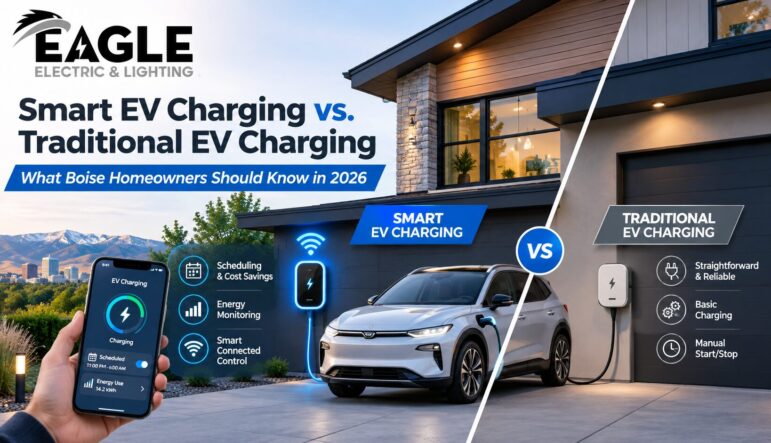
Choosing between smart and traditional EV charging is an important decision for Boise homeowners in 2026. Whether you’re driving an electric vehicle through Downtown Boise, commuting from Meridian, or returning home to Eagle after a long day, the right charging setup can make daily driving more convenient and potentially reduce electricity costs. Professional EV Charger Installation helps ensure your home charging station operates safely, efficiently, and reliably throughout Idaho’s changing seasons. Understanding the differences between smart and traditional chargers will help you choose a system that fits your driving habits, electrical capacity, and budget.
Not every home EV charging station works the same way. Traditional chargers focus on delivering electricity safely and consistently, while smart chargers add connected features that help homeowners monitor and manage charging. Both options can provide dependable charging when properly selected and installed. The difference comes down to how much control, automation, and flexibility you want.
Traditional EV chargers provide a straightforward way to recharge your vehicle without requiring Wi-Fi connectivity or a smartphone application. A basic Level 2 charger connects to your home’s 240-volt electrical system and delivers power according to the charger’s rating and the vehicle’s capabilities. Once connected, charging generally begins automatically unless the vehicle has its own charging schedule. This simplicity appeals to homeowners who prefer dependable equipment without additional connected features.
Traditional charging equipment can be particularly practical for households with predictable driving schedules. For example, a Boise homeowner who drives a short distance each day and charges overnight may not need advanced monitoring features. Many electric vehicles already include built-in charging timers, allowing drivers to schedule charging without purchasing a network-connected station. A conventional Level 2 charger can therefore offer excellent everyday value.
Smart EV chargers use connected technology to give homeowners greater visibility and control over charging sessions. Depending on the model, these devices can communicate through Wi-Fi, Bluetooth, or other network connections. Instead of simply supplying electricity, they may allow users to schedule charging, monitor energy consumption, receive notifications, and adjust charging settings remotely. Some advanced models also support electrical load management or coordination between multiple vehicles.
Common smart EV charging features include:
Smart technology does not automatically make a charger faster. Charging speed depends on the electrical circuit, charger output, and vehicle’s onboard charging limits. A traditional 40-amp Level 2 charger can deliver the same power as a smart 40-amp Level 2 charger under comparable conditions. The main advantage of smart charging is greater control over when and how that electricity is used.
Boise’s combination of established neighborhoods, expanding residential developments, and seasonal weather conditions makes home charging requirements different from one property to another. A charging station that works well in a newer Southeast Boise home may require a different electrical approach in an older North End residence. Before purchasing equipment, homeowners should understand their electrical system’s available capacity and where the vehicle will be parked.
Homes throughout the North End, Boise Bench, and Warm Springs areas may have electrical systems installed or modified during different decades. Some properties have undergone major renovations, while others retain older service panels or limited available circuit capacity. Adding a Level 2 EV charger introduces a substantial continuous electrical load that must be considered alongside heating, air conditioning, cooking equipment, and other household appliances. The age of a home alone does not determine whether its panel needs replacement.
For example, a charger delivering 32 amps continuously generally requires a properly designed 40-amp branch circuit, while a 40-amp charger generally requires a 50-amp circuit. These relationships reflect electrical code requirements for continuous loads, but the home’s overall service capacity must also be evaluated. A qualified electrician can perform a load calculation and determine whether a dedicated circuit, approved load-management equipment, or electrical service upgrade is appropriate. Installing a larger charger without checking available capacity can create avoidable safety problems.
Treasure Valley weather also influences EV charging decisions. During hot Boise summers, household air conditioners may operate for extended periods, increasing overall electrical demand. Smart chargers equipped with compatible load-management technology can sometimes reduce charging output while other major appliances are operating. However, this capability must be supported by the specific equipment and installed according to applicable electrical requirements.
Cold winter temperatures can also affect battery charging efficiency and available driving range. Battery management systems may use additional energy to warm the battery, and vehicles parked outdoors may experience different charging behavior from those stored in insulated garages. Homeowners in Harris Ranch, Southeast Boise, and communities near the Boise Foothills should consider whether an indoor or outdoor charging location better suits their property. Outdoor installations require appropriately rated equipment and suitable protection from environmental exposure.
One of the most useful smart charging features is the ability to schedule electricity consumption around utility pricing. For customers served by Idaho Power, the optional residential Time-of-Use plan provides different electricity rates depending on the season and time of day. This makes charging schedules particularly relevant for homeowners who can leave their vehicles plugged in overnight. However, lower charging costs are not guaranteed unless the household is enrolled in an appropriate rate plan.
Under Idaho Power’s published residential Time-of-Use pricing, summer rates from June through September include an on-peak energy charge of approximately 29.92 cents per kilowatt-hour between 7 p.m. and 11 p.m., Monday through Saturday. The summer off-peak energy rate is approximately 7.48 cents per kilowatt-hour, applying from 11 p.m. to 3 p.m. the following day. Sundays and designated holidays receive off-peak pricing throughout the day. These figures represent energy charges rather than every component of a customer’s electric bill.
Consider a household using 30 kilowatt-hours of metered electricity for charging. At the listed summer on-peak rate, the energy charge would be approximately $8.98, compared with approximately $2.24 at the off-peak rate. This illustration demonstrates how scheduling can affect energy charges, although actual costs depend on the applicable tariff, additional bill components, and charging losses. Homeowners should confirm their current pricing through Idaho Power before estimating savings.
During the October-through-May period, Idaho Power’s published Time-of-Use plan identifies weekday and Saturday peak periods from 6 a.m. to 9 a.m. and 5 p.m. to 8 p.m. The posted non-summer peak energy rate is approximately 13.83 cents per kilowatt-hour, compared with approximately 9.22 cents during off-peak hours. These seasonal differences mean a schedule that works well during summer may need adjustment when fall arrives. Smart chargers can simplify this process when their software supports configurable seasonal schedules.
A traditional charger can also benefit from lower-rate periods if the vehicle itself supports scheduled charging. The financial benefit comes primarily from shifting electricity consumption, not from the smart label on the charger. Homeowners should compare the optional Time-of-Use plan with their existing standard residential rate before making changes. Smart charging offers the greatest practical advantage when its automation matches the household’s actual electricity plan and driving routine.
Across the Treasure Valley, charging requirements often depend more on daily mileage, garage accessibility, and electrical infrastructure than on the city itself. Nevertheless, local housing layouts and commuting patterns can influence the most convenient installation. Homeowners should consider how often they drive, whether they own multiple vehicles, and where charging equipment can be mounted safely.
For homeowners traveling between Boise and Meridian, a dedicated Level 2 charger can make overnight charging more practical. According to the U.S. Department of Energy, Level 1 charging generally adds approximately 2 to 5 miles of range per hour, while Level 2 charging can add approximately 10 to 30 miles per hour depending on equipment and vehicle characteristics. This makes Level 2 equipment especially useful for longer commutes, larger battery packs, or unpredictable driving schedules.
Residents near Downtown Boise, the Boise River Greenbelt, and Meridian’s Settlers Park area may prioritize convenience and compact garage installations. A traditional charger may be sufficient for a single vehicle with modest daily mileage. Households with two EVs, changing work schedules, or a desire to monitor electricity consumption may benefit more from smart equipment. The best solution is the one that reliably restores the necessary driving range before the next trip.
In Eagle neighborhoods near Eagle Island State Park and developing residential areas of Star and Middleton, homeowners may have different garage layouts, longer driveways, or detached parking structures. These conditions can affect cable routing, mounting locations, and installation expenses. A charger positioned farther from the main electrical panel may require additional conduit, wiring, or trenching. The installation design should account for both present needs and potential future vehicles.
Families planning to purchase a second EV should ask about systems that support coordinated charging. Certain smart chargers can share available circuit capacity through manufacturer-approved configurations, potentially avoiding unnecessary simultaneous electrical demand. This does not mean two chargers can simply be connected to any existing circuit. Equipment compatibility, circuit design, and approved load-sharing methods must be evaluated before installation.
Homeowners in Nampa, Caldwell, and Emmett may regularly travel between communities for employment, shopping, appointments, and family activities. For those making longer daily trips, dependable overnight charging can reduce the need to rely on public charging stations. A properly sized Level 2 charger provides flexibility without necessarily requiring the highest available charging output. Vehicle battery size, driving distance, and overnight parking duration should guide the decision.
Properties near Lake Lowell, Caldwell’s Indian Creek area, or the outskirts of Emmett may also have unique electrical layouts. Detached garages, exterior parking spaces, and long distances from the panel can increase installation complexity. Outdoor-rated equipment, appropriate cable protection, and weather-resistant mounting are important considerations. These factors can influence installation costs more significantly than whether the charger has smart connectivity.
A reliable charging setup requires more than mounting equipment and connecting wires. EV charging equipment places sustained demand on household electrical systems, making proper circuit design and installation essential. Professional installation should address electrical capacity, equipment compatibility, physical placement, permitting, and safe operation. These considerations apply equally to traditional and smart chargers.
The installation process should begin with an evaluation of the existing electrical panel, service capacity, available breaker space, and proposed charger location. The electrician should also confirm the vehicle’s charging specifications and connector compatibility, including J1772 or North American Charging Standard connections where applicable. Charger output should be matched to the available electrical capacity rather than selected solely for maximum advertised speed. Some homeowners can obtain excellent performance from a moderately powered charger without needing a major panel upgrade.
Hardwired chargers and plug-in chargers also have different installation considerations. A hardwired unit connects directly to a dedicated branch circuit, while a plug-in model requires a properly rated receptacle and associated protections. Receptacle-based installations may require additional GFCI protection under the applicable electrical code. Household extension cords, improvised adapters, and unsuitable outlets should never be treated as substitutes for a properly designed EV charging circuit.
Boise’s electrical code generally requires permits for regulated electrical installation work unless a specific exemption applies. Other Treasure Valley jurisdictions may have their own permitting procedures or applicable state requirements. Homeowners should confirm the correct authority before construction begins and ensure required inspections are completed. Using qualified electrical professionals helps reduce the risks associated with improper wiring, overloaded circuits, or unsuitable equipment.
The U.S. Department of Energy’s guidance on charging electric vehicles at home recommends safety-certified equipment and appropriate electrical installation. Homeowners should look for chargers evaluated by recognized testing laboratories and installed according to manufacturer instructions. A properly completed installation should include functional testing, confirmation of charging operation, and instructions for safe everyday use. For connected chargers, configuration of Wi-Fi access and charging schedules may also be necessary.
The total cost of residential EV charging depends on the equipment selected and the electrical work required. A straightforward installation near an adequately sized panel may be less expensive than one involving extensive wiring, trenching, or service upgrades. Smart chargers can carry higher equipment costs because of their connectivity and monitoring features. However, advanced functions are valuable only when homeowners actually use them.
Before approving an installation, request a written estimate that identifies the charger, dedicated circuit, wiring route, any required panel modifications, and applicable permit costs. Ask whether the proposed installation can accommodate a future vehicle or charging upgrade. Homeowners should also verify available utility programs rather than assuming rebates or tax credits apply. In particular, the federal Alternative Fuel Vehicle Refueling Property Credit ended for property placed in service after June 30, 2026, so new installations completed later in 2026 should not be budgeted around that credit.
Smart charging is often attractive for households that want automated scheduling, energy monitoring, or compatibility with advanced electrical management systems. A homeowner with a demanding commute between Star and Boise may appreciate charging notifications and the ability to adjust schedules remotely. Similarly, a household managing two electric vehicles may benefit from compatible power-sharing features. These advantages become more meaningful as charging requirements become more complex.
Traditional charging remains a reasonable choice for households that simply need reliable overnight charging. If the vehicle already provides scheduling controls and the household does not need energy monitoring, a conventional Level 2 unit may meet every practical requirement. Choosing a simpler charger can also reduce dependence on manufacturer applications or network connectivity. Neither technology is universally better for every homeowner.
Before making a final decision, consider the following questions:
Answering these questions will help narrow the options before equipment is purchased. A professional electrical assessment can then determine which charging configurations are appropriate for the property. For many Boise-area homeowners, the most important investment is a safe, properly sized Level 2 charging circuit. Smart features can be added where they provide meaningful convenience or energy-management benefits.
Smart EV charging is generally better for homeowners who want automated schedules, energy monitoring, and remote management. Traditional charging can be equally effective for supplying electricity to a vehicle and may cost less upfront. If your EV already supports scheduled charging, you may not need a connected charger to take advantage of off-peak electricity rates. The right choice depends on your driving habits, utility plan, and preferred level of control.
Installation costs vary according to electrical panel capacity, charger output, wiring distance, mounting location, and permit requirements. A simple installation near an existing panel may be considerably less expensive than a project requiring trenching or electrical service upgrades. Smart chargers may also cost more than comparable traditional units because of their additional features. A site-specific estimate is the most reliable way to determine the total investment for your Boise home.
No, a 200-amp service is not automatically required for every Level 2 EV charger installation. Some homes with smaller electrical services can accommodate appropriately sized charging equipment after a proper load calculation. Others may benefit from an approved energy-management system or require an electrical upgrade. A qualified electrician should evaluate the complete household load before recommending equipment or service modifications.
Smart charging may reduce electricity expenses when a homeowner is enrolled in a rate plan that rewards charging during lower-cost periods. Idaho Power’s optional residential Time-of-Use plan provides different energy rates depending on the season and time of day. Scheduling charging outside peak periods can help eligible customers take advantage of lower energy charges. However, smart equipment does not automatically lower rates, and savings depend on household usage and the selected electricity plan.
Level 2 charging commonly adds approximately 10 to 30 miles of driving range per hour, although actual performance varies. Charging speed depends on the circuit capacity, the charger, the vehicle’s onboard charging equipment, and battery conditions. For example, a vehicle charging at approximately 7.7 kilowatts may receive around 46 kilowatt-hours of electricity over six hours before accounting for charging losses or vehicle limitations. Many drivers can therefore replenish typical daily mileage during overnight parking.
Yes, residential EV chargers can be installed outdoors when the selected equipment is approved for that environment and the installation meets applicable electrical requirements. Outdoor locations should account for rain, snow, temperature changes, physical damage, and cable management. An electrician can recommend suitable mounting arrangements and confirm the proper installation method. This is particularly useful for homes with driveway parking, carports, or detached garages.
Many smart EV chargers can continue basic charging operations without an active internet connection, but functionality varies by manufacturer and model. Remote monitoring, notifications, cloud-based scheduling, and software updates may become unavailable until connectivity returns. Some chargers retain previously configured schedules, while others have different offline behavior. Review the manufacturer’s specifications before purchasing if dependable offline operation is important to your household.
Whether you prefer the simplicity of traditional charging or the convenience of smart technology, a properly installed home charger can make electric vehicle ownership easier. The right system should complement your driving routine, work within your home’s electrical capabilities, and provide dependable performance through Boise’s hot summers and cold winters. Making an informed choice today can also help prepare your property for changing transportation needs.
Eagle Electric & Lighting provides residential electrical services and professional home EV charging station installation throughout Boise, Eagle, Star, Meridian, Middleton, Caldwell, Emmett, and Nampa. Our licensed electricians can evaluate your electrical system, discuss suitable charging equipment, and recommend a safe installation approach for your property. Whether you need a new dedicated charging circuit, a Level 2 charger, or an electrical panel assessment, we’re here to help you make a confident decision.
Ready to charge your electric vehicle conveniently at home? Contact Eagle Electric & Lighting at (208) 781-0220 to discuss your charging needs and request an installation estimate. Discover how professional EV Charger Installation can provide reliable, convenient home charging for your Treasure Valley lifestyle in 2026 and beyond.