Mon-Fri 07:00 AM - 05:00 PM
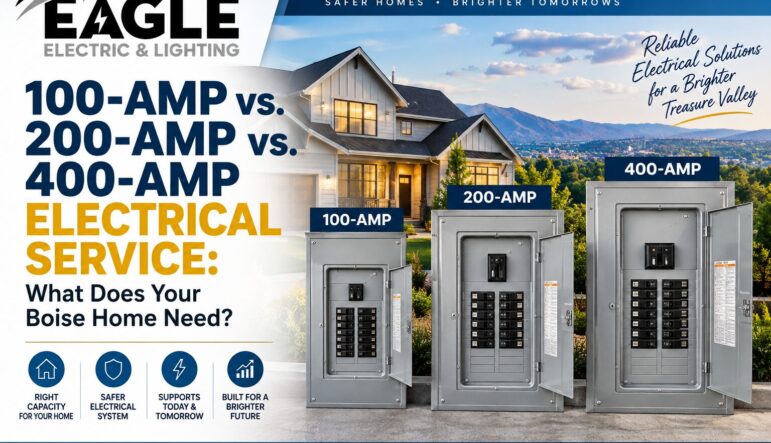
Choosing between a 100-amp, 200-amp, and 400-amp electrical service is not simply a matter of picking the largest number. For homeowners researching Eagle Electrical Panel Repair & Replacement, the right service capacity depends on the home’s size, age, electrical equipment, heating and cooling systems, future upgrades, and calculated electrical load. A home in Boise’s North End may have very different electrical needs from a newer property in Harris Ranch, while a large custom home near Eagle Island or a property with an EV charger, pool, workshop, and all-electric HVAC may require substantially more capacity.
In the Treasure Valley, homeowners in Boise, Eagle, Star, Meridian, Middleton, Caldwell, Emmett, and Nampa are increasingly adding high-demand electrical equipment to their homes. Understanding what 100 amps, 200 amps, and 400 amps actually mean can help you recognize when an existing electrical panel is becoming a limitation and when an electrical panel repair or replacement should be evaluated by a qualified electrician.
The amp rating describes the maximum electrical current the home’s service equipment is designed to handle under the applicable electrical requirements. At a typical 120/240-volt residential service, a 100-amp service represents roughly 24,000 volt-amperes of theoretical service capacity, while a 200-amp service represents roughly 48,000 volt-amperes. A 400-amp service provides approximately twice the current capacity of a 200-amp service, but the actual usable load must be determined through an appropriate electrical load calculation rather than by simply adding appliance nameplate ratings.
This distinction is important when considering a panel upgrade. A larger breaker does not automatically make an existing service capable of carrying a larger load. The service entrance conductors, meter equipment, disconnects, panelboard, grounding and bonding, utility connection, and other components must be compatible with the proposed service. Idaho Power’s current customer-service requirements list residential 120/240-volt meter bases in 100-amp, 200-amp, 320-amp, and 400-amp ratings, illustrating that larger residential services are possible when the project is designed and coordinated correctly.
A 100-amp service can be found in older homes and smaller residences, particularly properties where the original electrical system was designed around a more limited collection of appliances. It may be adequate when the home has moderate electrical demand, gas-fired heating and water heating, conventional appliances, and no major plans for additional high-load equipment.
The challenge comes when a homeowner adds equipment that was not part of the home’s original electrical design. An electric vehicle charger, electric range, heat pump, electric water heater, hot tub, workshop equipment, or other substantial loads can make an older 100-amp service much more restrictive. Frequent breaker trips, flickering lights, overheating equipment, or an inability to add new circuits can be warning signs that the electrical system deserves professional evaluation.
For many modern single-family homes, 200 amps provides substantially more flexibility than a 100-amp service. It is commonly considered when a home has central heating and cooling, multiple major appliances, an electric range, laundry equipment, several electronic systems, and plans for future electrical additions.
A 200-amp service can also provide useful capacity for homeowners planning an EV charger, heat pump, home office, workshop, or other electrical improvements. However, even a 200-amp service should not be assumed to have unlimited capacity. The electrician should evaluate the actual and anticipated loads before adding major equipment or recommending an upgrade.
A 400-amp residential service is a significantly larger installation and is generally associated with homes or properties having unusually high electrical demand. Examples can include large custom homes with extensive all-electric systems, multiple EV chargers, large HVAC equipment, electric water heating, swimming pools, spas, detached workshops, extensive outdoor electrical equipment, or other substantial loads operating together.
400 amps should not be viewed as a premium option that every homeowner should install simply because it provides more capacity. Larger service equipment can involve larger conductors, meter equipment, conduit, service equipment, utility coordination, and project costs. Idaho Power’s current residential service information specifically provides requirements for 400-amp service, including larger conduit requirements than 200-amp installations.
Boise has a wide mixture of older homes, remodeled properties, newer construction, historic neighborhoods, and larger modern residences. A house in the North End or East End may have an electrical system that has been modified several times over decades, while newer homes around Southeast Boise, Harris Ranch, and other developing areas may have been designed around substantially different electrical loads.
Historic and established areas can present a particular panel-replacement challenge because the current electrical demand may be considerably higher than the demand anticipated when the home was originally built. Homeowners may have added central air conditioning, modern kitchen appliances, home offices, EV charging, additional living space, or electric heating without completely redesigning the service.
Local surroundings can also influence how homeowners use their electrical systems. Properties close to the Boise Foothills, Boise River Greenbelt, Warm Springs, and established residential areas may have very different combinations of indoor and outdoor electrical equipment. The important question is not whether a particular Boise neighborhood automatically requires 100, 200, or 400 amps, but whether the individual home’s calculated demand matches the service equipment installed at the property.
An electrical panel does not necessarily need to be replaced simply because it is old. However, visible damage, overheating, corrosion, repeated breaker trips, outdated equipment, insufficient breaker spaces, or an inability to safely accommodate new circuits can justify an inspection. Panel problems can also be symptoms of larger service or wiring issues that should be evaluated before additional loads are connected.
These symptoms should not be used as a do-it-yourself diagnosis. Electrical service equipment can contain dangerous voltages even when individual branch circuits are switched off. A qualified electrician can determine whether the problem is isolated to a circuit, related to the panel, or associated with the home’s overall service capacity.
Modern homes can place substantially different demands on an electrical system than homes built several decades ago. The U.S. Energy Information Administration identifies air conditioning, space heating, and water heating among the largest categories of residential electricity use. For Boise-area homeowners, the combination of summer cooling demand and winter heating requirements can become especially relevant when a property transitions toward more electric equipment.
Consider a homeowner in Boise who already has central air conditioning and an electric range. Adding an EV charger may create a new significant load. Adding an electric water heater and heat pump later can increase the overall demand again. A homeowner in Eagle may have the same issue, but the property could also include a large detached garage, workshop, pool equipment, or multiple vehicles requiring charging.
Homeowners in Star, Meridian, Middleton, Caldwell, Emmett, and Nampa should use the same principle. City limits do not determine the correct service size. The home’s equipment, electrical design, service characteristics, and calculated load do.
EV charging is one of the most common reasons homeowners investigate service capacity before making an electrical upgrade. A charger can add a substantial continuous electrical load, and two EV chargers can create a considerably larger demand. That does not automatically mean a homeowner needs 400 amps; an electrician may determine that the existing service can support the charger or that another electrical-management solution is appropriate.
If you are planning an EV charger installation, discuss the project before purchasing equipment. The electrician can evaluate the service rating, available panel capacity, charger requirements, existing loads, and future plans. This approach can prevent homeowners from installing a charger first and discovering afterward that the electrical service needs additional work.
Boise homes may use a combination of gas and electric equipment, while some newer or remodeled homes use more electric systems. Heat pumps, electric resistance heating, central air conditioning, electric water heaters, induction ranges, dryers, and other major appliances can collectively affect a home’s electrical load.
The U.S. Energy Information Administration reports that air conditioning alone accounted for about 19% of residential electricity consumption in its 2020 national data. That figure is national rather than Boise-specific, but it demonstrates why HVAC equipment deserves careful consideration when evaluating a home’s electrical requirements.
The best way to compare service sizes is to consider the home’s current electrical equipment and its foreseeable future needs rather than choosing the largest available service. A smaller home with modest electrical demand may not benefit from a 400-amp installation, while a large all-electric home with several major loads may require considerably more capacity than an older 100-amp service can provide.
There is no universal service size that is correct for every Boise-area home. A proper evaluation considers the calculated load, service equipment, conductors, meter requirements, available utility service, existing electrical conditions, and planned improvements.
Homeowners searching for Eagle Electrical Panel Repair & Replacement may actually be dealing with several different situations. Some need a repair to a damaged component, some need additional circuit capacity, and others need a complete service upgrade. Those situations should be distinguished before work begins because replacing a panel is not necessarily the same as upgrading the home’s electrical service.
In Eagle, electrical work is subject to permitting and inspection requirements. The City of Eagle provides electrical permitting resources for residential and commercial projects, and service upgrades may require coordination among the electrician, permitting authority, and electric utility. This is particularly important for larger services where meter bases, service conductors, conduit, and utility equipment may need to be compatible with the proposed installation.
The same planning principle applies throughout Boise, Star, Meridian, Middleton, Caldwell, Emmett, and Nampa. If you are remodeling a kitchen, adding an ADU or workshop, installing an EV charger, converting heating equipment to electric, or building a larger home, it is smart to evaluate service capacity before electrical work begins.
A common misconception is that a larger electrical panel automatically provides more electrical capacity. It does not. A panel with more breaker spaces may make circuit organization easier, but the home’s service capacity is determined by the complete electrical service and the applicable load calculation.
For example, replacing a crowded 200-amp panel with another 200-amp panel may solve a panel-condition or space problem without increasing service capacity. Conversely, upgrading from 100 amps to 200 amps is a larger project because the service components must be evaluated as a system. The correct solution depends on what the electrician finds at the property.
A professional evaluation should begin with an assessment of the existing panel and service equipment. The electrician can identify the service rating, inspect the panel’s condition, review major branch circuits, consider existing electrical loads, and discuss planned additions such as EV chargers, HVAC equipment, pools, hot tubs, workshops, or electric appliances.
If a service upgrade is appropriate, the project may involve more than changing the main breaker. Depending on the property, work can include replacing the panel, service disconnect, meter equipment, service entrance conductors, grounding and bonding components, and associated raceways or wiring. Utility requirements and local permitting should also be considered before construction begins.
For Boise homeowners, the City of Boise provides electrical permitting and inspection information, including requirements related to electrical work and inspections. Planning the permit and inspection process before starting work helps reduce the risk of unexpected project delays.
Not every Boise home automatically needs 200 amps. The appropriate service size depends on the home’s calculated electrical load, existing equipment, service components, and future electrical plans. Many homeowners consider 200 amps when their existing 100-amp service has become restrictive because of modern appliances or planned upgrades.
It can be, depending on the home’s electrical demand. A 100-amp service may work for a residence with moderate loads, but an evaluation is worthwhile before adding equipment such as an EV charger, electric water heater, heat pump, hot tub, or large workshop equipment.
A 400-amp service may be considered for a large, high-demand residence with multiple major electrical loads operating together. Examples can include extensive all-electric HVAC, several EV chargers, electric water heating, pool and spa equipment, a large workshop, or other substantial loads. A load calculation and utility coordination are important before selecting this service size.
Not necessarily. A panel replacement can improve the condition, safety, organization, or available circuit spaces of the electrical equipment while keeping the same service rating. Increasing capacity requires evaluating the complete service and determining whether an actual service upgrade is necessary.
It depends on the home’s existing electrical load and the charger’s requirements. Some 100-amp services may have enough calculated capacity, while others may require an upgrade or another engineered solution. Have the service evaluated before installing the charger.
Electrical permitting and inspection requirements depend on the location and scope of the work. Boise and Eagle both provide permitting resources for electrical projects, so homeowners should verify the applicable requirements before beginning a panel or service project. A qualified electrical contractor can help coordinate the appropriate permit and inspection process.
Not automatically. Future planning is important, but oversizing a service can add unnecessary equipment and project costs. A better approach is to identify realistic future loads—such as EV charging, HVAC changes, electric water heating, a pool, or a workshop—and have the electrical service evaluated against those requirements.
The difference between 100-amp, 200-amp, and 400-amp electrical service is ultimately about matching electrical infrastructure to the home’s actual and anticipated demand. A 100-amp service may remain suitable for some properties, 200 amps can provide greater flexibility for many modern homes, and 400 amps may be appropriate for unusually high-demand residences. The correct answer should come from an electrical evaluation and load calculation—not from a one-size-fits-all recommendation.
Whether your home is in Boise’s North End, East End, Harris Ranch, or another neighborhood, or you live in Eagle, Star, Meridian, Middleton, Caldwell, Emmett, or Nampa, addressing panel problems early can make future electrical improvements easier to plan. If you are experiencing breaker problems, planning an EV charger, remodeling your home, adding major electric appliances, or considering a service upgrade, contact a qualified electrician to evaluate your existing electrical system and determine the appropriate next step.
Eagle Electrical Panel Repair & Replacement can be part of a broader electrical evaluation designed around your home’s current requirements and future plans. A professional assessment can help determine whether you need a repair, a panel replacement, additional circuit capacity, or a complete electrical service upgrade for your Boise-area home.