Mon-Fri 07:00 AM - 05:00 PM
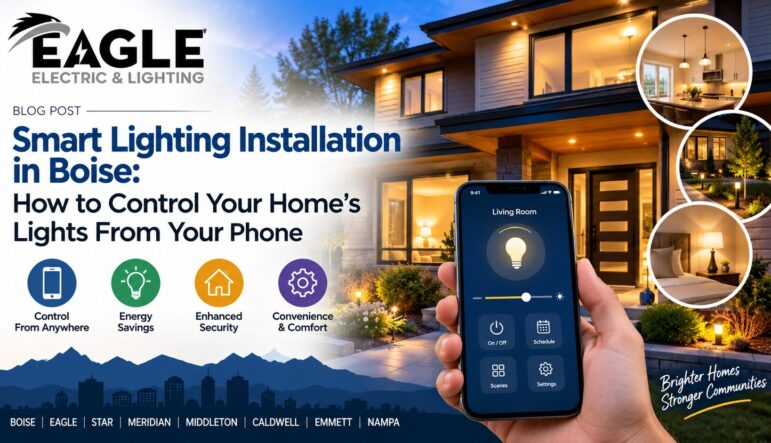
Smart lighting has changed the way homeowners think about convenience, comfort, security, and energy use. With Eagle Lighting Services, homeowners in Boise and surrounding Treasure Valley communities can move beyond traditional wall switches and manage compatible lights from a smartphone, set schedules, create scenes, adjust brightness, and turn lights off remotely. Whether you live in Boise’s North End, Harris Ranch, East End, or a newer home in Eagle, Star, Meridian, Middleton, Caldwell, Emmett, or Nampa, a properly planned smart lighting installation can make everyday lighting easier to control.
Smart lighting installation combines compatible LED fixtures, smart bulbs, connected switches, dimmers, sensors, hubs, and mobile applications so homeowners can control lighting from a phone or another connected device. Depending on the system selected, you may be able to turn individual lights on and off, dim them, change color temperature, create schedules, activate scenes, or control lighting while you are away from home.
The important distinction is that smart lighting is more than simply replacing a light bulb. A successful installation requires the lighting equipment, switches, wiring, dimming controls, communication method, and home network to work together. In some homes, a smart bulb may be sufficient. In others, a professionally installed smart switch or dimmer is a better solution because family members can continue using the wall switch normally while also gaining app-based control.
For Boise homeowners, this can be particularly useful when combining interior lighting with exterior entry lights, pathway lighting, garage lighting, landscape lighting, or security-oriented lighting. A thoughtful system can give you control over multiple areas without requiring you to walk from room to room turning individual fixtures on and off.
Boise contains a mixture of historic homes, established residential neighborhoods, remodeled properties, and newer developments. The North End, East End, Hyde Park, Warm Springs, and Harris Ranch can have very different home layouts and electrical configurations. Older properties may require closer attention to existing wiring, switch boxes, fixture compatibility, and previous remodeling work, while newer homes may provide more flexibility for integrated lighting controls.
Smart lighting can also be useful around the Boise River Greenbelt, residential properties near Julia Davis Park, and homes throughout Southeast Boise where homeowners may want outdoor lighting schedules that complement evening activities without leaving exterior lights running unnecessarily all night. The right setup depends on the property, the existing electrical system, the homeowner’s routine, and the type of lighting being controlled.
Energy efficiency is another consideration. The U.S. Department of Energy notes that LEDs use substantially less energy than traditional incandescent lighting and can last much longer. ENERGY STAR also highlights features such as scheduling, occupancy sensing, geofencing, and remote control as ways connected lighting can help homeowners manage when lights operate. ENERGY STAR smart lighting guidance provides additional information about these features.
Smart bulbs are one of the simplest ways to introduce connected lighting. The bulb contains the electronics required to communicate with an application, allowing a homeowner to control it through a smartphone. Depending on the product, controls may include on/off operation, dimming, white-color adjustment, color-changing capabilities, schedules, and automation.
Smart bulbs can work well for lamps, decorative fixtures, and selected individual lighting points. However, they are not always the best choice for an entire home. If a wall switch is turned off, the smart bulb generally loses power and cannot respond to an app until electricity is restored. For frequently used rooms, a smart switch may provide a more practical long-term solution.
Smart switches replace or supplement conventional wall switches and can control standard compatible light fixtures from a phone. This approach is particularly useful for kitchens, hallways, bedrooms, living rooms, garages, exterior lights, and other areas where multiple people regularly use the wall control.
Smart dimmers require additional attention because not every LED fixture or bulb is compatible with every dimmer. Flickering, buzzing, limited dimming range, or inconsistent operation can occur when incompatible equipment is combined. A professional installation can help determine whether the existing fixture, bulb, wiring, and control are appropriate for the desired system.
Not every smart lighting product communicates in the same way. Some devices connect directly through Wi-Fi, while others use Bluetooth or a hub-based communication system. Bluetooth can be convenient for nearby control, but it may not provide the same remote-control capabilities as an internet-connected system.
For a larger Boise-area home, network coverage should be considered before installing numerous connected devices. A lighting system that works perfectly near the router may behave differently in a garage, detached space, basement, or distant bedroom. Some systems use hubs or mesh technologies to improve communication between devices, which can be useful when planning whole-home lighting control.
Homes in Boise’s North End and East End can have architectural details and older electrical configurations that deserve careful evaluation before adding connected controls. A homeowner may want modern phone-based lighting control without changing the character of the property. In these situations, the goal is to integrate modern functionality while respecting the existing electrical infrastructure and fixture design.
Projects around Hyde Park and Warm Springs may involve a combination of decorative lighting, recessed fixtures, hallway lights, exterior fixtures, and older switch locations. Rather than assuming that one smart product will work everywhere, each circuit should be evaluated for compatibility and the intended control method.
Newer or substantially remodeled homes around Harris Ranch and Southeast Boise may provide opportunities for more comprehensive lighting automation. Homeowners can combine kitchen, living-area, bedroom, entry, patio, and landscape lighting into scenes designed around everyday routines.
For example, an evening scene could reduce living-room brightness while turning on selected exterior lights. An away schedule could switch off nonessential interior lighting while maintaining selected exterior illumination. These automations can be controlled from a phone and adjusted as household routines change.
Smart lighting is not limited to Boise. Homeowners in Eagle neighborhoods and developments, around Eagle Island, and throughout Star can use connected lighting for kitchens, outdoor areas, garages, and entryways. Meridian homeowners may integrate smart controls into newer subdivisions, remodeled properties, and homes near major shopping and residential areas such as the Ten Mile corridor.
In Middleton, Caldwell, Emmett, and Nampa, homeowners may have different property layouts, detached garages, larger lots, workshops, or exterior lighting requirements. These conditions can influence whether Wi-Fi-connected bulbs, smart switches, sensors, or a hub-based system makes the most sense. A lighting plan should account for the entire property rather than focusing only on the smartphone application.
One of the most common problems with connected lighting is assuming that every LED bulb can be dimmed by every smart dimmer. Compatibility depends on the bulb, fixture, dimmer, minimum load, and manufacturer’s specifications. A system that is not properly matched can produce flickering or poor dimming performance.
Some smart switches require a neutral wire or have other installation requirements that vary by product. Older homes can have wiring configurations that differ from newer construction. Before purchasing several switches, homeowners should verify that the selected equipment is appropriate for the existing electrical system.
A smart lighting system is only convenient when the homeowner can reliably communicate with it. Weak Wi-Fi coverage, an overloaded network, poor device placement, or incompatible communication standards can create frustrating control problems. Planning connectivity before installation is especially important for larger homes, detached garages, outdoor areas, and properties with multiple floors.
A phone should not be the only way to operate essential household lighting. Family members, guests, children, and visitors may still expect to use a traditional wall switch. A well-designed system should consider how smart controls and manual controls will work together so that convenience does not come at the expense of everyday usability.
Smart lighting can be designed around how a home is actually used rather than simply adding connected devices everywhere. A few practical applications include:
For Boise-area homeowners, outdoor lighting deserves special attention because it may be exposed to changing weather conditions and temperature extremes. Fixtures and controls should be rated for their intended location, and outdoor installations should be planned for durability rather than simply selecting the cheapest connected product.
Start by deciding what you actually want the system to accomplish. If the primary goal is controlling one lamp from a phone, a smart bulb may be enough. If the goal is controlling an entire room while keeping traditional wall-switch operation, a smart switch or dimmer may be more appropriate. Whole-home projects may require a combination of switches, fixtures, sensors, hubs, and a reliable communication network.
Also consider whether you want voice control, scheduling, occupancy detection, geofencing, color-temperature adjustment, or integration with other smart-home equipment. ENERGY STAR notes that smart lighting products can provide remote control, scheduling, occupancy-based operation, and geofencing. More features can also mean greater complexity, so homeowners should select functionality that genuinely improves how they use the home.
For electrical work involving switches, dimmers, new wiring, fixtures, circuits, or troubleshooting, safety should remain the first consideration. The U.S. Consumer Product Safety Commission provides a home electrical safety checklist for homeowners, and electrical modifications should be approached carefully rather than treated as a simple app or technology project.
A professional lighting project should begin with an assessment of the home’s existing lighting and electrical configuration. This can include identifying the circuits involved, reviewing switch locations, checking fixture compatibility, determining whether smart dimming is appropriate, and considering how the homeowner wants to control the finished system.
The installation process can then be tailored to the property. That may mean replacing selected switches, installing compatible dimmers, upgrading fixtures to LEDs, adding sensors, configuring connected controls, or creating a coordinated system for interior and exterior lighting. The objective is not simply to make lights controllable from a phone, but to create a system that remains practical when the phone is not being used.
For homeowners searching for Eagle Lighting Services in Boise, Eagle, Star, Meridian, Middleton, Caldwell, Emmett, or Nampa, it is worth discussing the entire project before purchasing equipment. Professional planning can help reduce compatibility issues and ensure that the final installation fits the home’s electrical system, lighting requirements, and daily routines.
Yes. Compatible smart bulbs, switches, dimmers, and lighting systems can allow homeowners to control lights from a smartphone. Depending on the equipment, you may also be able to create schedules, dim lights, control scenes, or operate selected lighting while away from home.
Smart lighting can be installed in many older homes, but the existing wiring and electrical configuration should be evaluated first. Homes in established areas such as the North End, East End, and Warm Springs can have different wiring conditions than newer construction, so product compatibility should be confirmed before installation.
It depends on the technology used. Some systems have limited local control, while others rely heavily on an internet connection. Hub-based systems may continue communicating locally even when internet access is interrupted, depending on the specific equipment and configuration.
LED technology generally uses substantially less energy than traditional incandescent lighting. Smart controls can add another layer of efficiency by allowing homeowners to schedule lighting, use occupancy detection, turn lights off remotely, or reduce unnecessary operation.
Sometimes, but compatibility must be confirmed. The LED fixture or bulb should be rated for dimming, and the selected smart dimmer should support that particular type of load. If the products are mismatched, homeowners may experience flickering, buzzing, limited dimming, or unreliable operation.
Yes, compatible outdoor fixtures, switches, timers, and controls can be incorporated into a smart lighting plan. Outdoor equipment must be appropriate for the installation environment, and the communication method should provide reliable coverage to patios, garages, pathways, and other exterior areas.
Neither option is automatically right for every home. Smart bulbs can be convenient for individual fixtures and lamps, while smart switches can provide whole-fixture control and preserve familiar wall-switch operation. A lighting professional can help determine which approach makes sense for each room and circuit.
Smart lighting can make everyday life more convenient while giving Boise-area homeowners greater control over how and when their lights operate. From historic homes in the North End and East End to newer properties in Harris Ranch, Eagle, Star, Meridian, Middleton, Caldwell, Emmett, and Nampa, the right system depends on the home’s electrical configuration, lighting goals, connectivity, and daily routines.
If you are considering phone-controlled lighting, LED upgrades, smart switches, dimmers, sensors, or a broader residential lighting project, start with a plan that prioritizes compatibility and safe installation. Contact Eagle Electric and Lighting to discuss your smart lighting needs and determine an appropriate lighting solution for your home.