Mon-Fri 07:00 AM - 05:00 PM
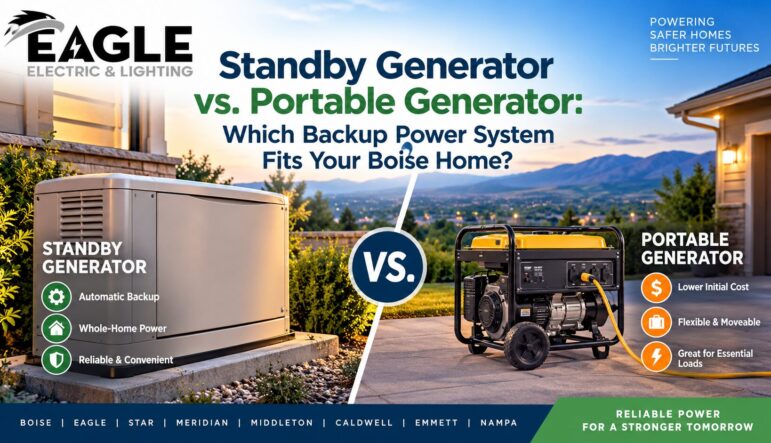
When Boise homeowners start comparing Electrical Generators for backup power, one question comes up quickly: should you install a permanently connected standby generator or purchase a portable generator? Both can provide valuable backup electricity, but they serve very different needs. The right choice depends on your home’s electrical load, budget, fuel availability, how long you expect outages to last, and whether you want automatic or manual backup power.
For homeowners in Boise, Eagle, Star, Meridian, Middleton, Caldwell, Emmett, and Nampa, generator planning should also account for Idaho weather, heating and cooling needs, home size, and the electrical equipment that matters most during an outage. This guide explains the practical differences between standby and portable generators so you can make an informed decision for your home.
Power interruptions can affect much more than lighting. Depending on the season, a Boise-area homeowner may need electricity for a furnace or heat pump, refrigerator, freezer, garage door opener, internet equipment, sump pump, security system, medical equipment, or home office. During hot summer weather, cooling equipment can become an important consideration, while winter outages can make reliable heating a priority.
Idaho Power identifies weather, equipment problems, vehicle accidents, wildfire or fire damage, trees and other objects, animals, third-party damage, and planned maintenance among the potential causes of power outages. Its outage information also notes that different parts of a neighborhood can be served by different circuits and may be restored at different times. That makes a properly planned backup power system useful for homeowners who need more control over essential electrical loads.
Local housing conditions can also influence generator planning. Boise contains established areas such as the North End, East End, Central Bench, Southeast Boise, and West Bench, with different home ages, layouts, electrical demands, and property configurations. For example, the Boise East End includes older established housing near the downtown core, while the West Bench contains a mixture of residential development and major commercial corridors. Generator placement and electrical planning should therefore be based on the individual property rather than a one-size-fits-all solution.
A standby generator is a permanently installed backup power system located outside the home. It is connected to the home’s electrical system through properly designed transfer equipment and can start automatically when utility power is interrupted. Depending on the generator and installation, standby systems commonly use natural gas or propane as their fuel source.
The biggest advantage is convenience. You do not normally need to move the generator into position, fill a gasoline tank, connect extension cords, or manually start the equipment every time the power goes out. A properly installed standby system can automatically transfer selected electrical loads, making it particularly attractive for homeowners who want continuous backup for important household systems.
A portable generator is designed to be moved and operated when needed. It is generally less expensive to purchase than a whole-home standby system and can be practical when a homeowner only wants to operate a limited number of essential appliances during an outage.
For example, a portable generator may be used to provide temporary power for a refrigerator, freezer, selected lights, internet equipment, or other approved loads. However, homeowners must understand its limitations. Portable generators require safe outdoor placement, fuel management, manual operation, and careful load management. They should never be used inside a house, garage, basement, shed, or other enclosed space.
A standby generator can be a strong fit for a Boise-area home where maintaining power to several important systems is a priority. It may be particularly useful for larger homes, households with critical electrical equipment, homeowners who travel frequently, or families who do not want to be outside managing a generator during a winter storm or nighttime outage.
Homeowners in areas such as Southeast Boise, Harris Ranch, the North End, East End, and Central Bench may have very different electrical layouts and equipment, so generator sizing should be based on actual electrical demand. A professional assessment can identify which circuits should remain powered and whether the home’s electrical service and panel configuration can accommodate the proposed system.
A portable generator can make sense when the primary objective is keeping a small number of essential appliances operating rather than powering an entire home. It can also be attractive to homeowners who want a lower initial equipment cost or who experience outages infrequently.
However, the lower purchase price does not eliminate the need for safe electrical planning. Idaho Power advises homeowners never to connect a portable generator directly to house wiring or plug it into a household outlet unless proper transfer equipment has been installed by a qualified professional. Improper connections can create dangerous electrical conditions and can send electricity back onto utility lines.
Generator size should be determined by the electrical loads you actually need during an outage. Instead of automatically assuming that every appliance must operate simultaneously, homeowners can identify essential circuits and prioritize them. This can make a major difference in the generator capacity required.
Typical priority loads may include refrigeration, heating equipment, lighting, internet and communications equipment, sump pumps, security systems, garage doors, and selected kitchen appliances. Some homes may also require backup power for well pumps, water systems, medical equipment, or other essential devices.
Large electrical loads deserve particular attention. Central air-conditioning systems, heat pumps, electric water heaters, electric ranges, clothes dryers, well pumps, and other high-demand equipment can significantly affect generator sizing. Starting loads can also be higher than the running wattage of certain motor-driven appliances, so a generator calculation should consider both operating and startup requirements.
Oversizing a generator can increase equipment and installation costs, while undersizing can cause overloads, nuisance shutdowns, or prevent important equipment from operating correctly. A qualified electrician can evaluate the home’s electrical panel, service capacity, circuits, appliances, and desired backup loads before recommending a generator configuration.
This is especially important when comparing homes in different Treasure Valley communities. A newer home in Meridian or Star may have a different electrical layout from an older Boise property, while homes in Eagle, Middleton, Caldwell, Emmett, and Nampa can vary considerably in size, heating systems, well equipment, and other electrical requirements.
Carbon monoxide is one of the most serious hazards associated with portable generators. The U.S. Consumer Product Safety Commission warns that generator carbon monoxide can kill within minutes and recommends operating portable generators outside, at least 20 feet away from the home, with exhaust directed away from windows, doors, and other openings.
A portable generator should never be operated inside a garage, even if the garage door is open. It should also never be placed near an air intake or other opening where exhaust could enter the house. Working carbon monoxide alarms on every level of the home and outside sleeping areas provide another important layer of protection.
Homeowners should also avoid connecting a portable generator to household wiring without the appropriate transfer equipment. Safe generator operation requires more than choosing a machine with enough wattage. The generator, connection method, electrical panel, grounding and bonding configuration, fuel system, and placement all need to be considered according to applicable requirements.
For additional consumer safety information, the U.S. Consumer Product Safety Commission’s generator safety guidance provides important information about carbon monoxide hazards and safe outdoor operation.
Generator planning is not limited to Boise. Homeowners throughout the Treasure Valley can have different backup-power requirements based on property size, electrical equipment, neighborhood layout, and utility service configuration.
In Eagle, properties around areas such as Downtown Eagle, Eagle Island, Floating Feather, Brookside, and River Plain can have substantially different home designs and lot configurations. The location of a generator, available fuel source, clearance requirements, and electrical connection should therefore be evaluated at the property rather than selected solely from a generic sizing chart.
In Star and Meridian, rapidly developing residential areas can include newer homes with modern electrical equipment and larger combinations of HVAC, kitchen, garage, and outdoor loads. In Middleton, Caldwell, Emmett, and Nampa, property characteristics can also vary from established neighborhoods to newer subdivisions and larger lots. Nampa’s planning documents, for example, identify areas including North Nampa, City Center, the University District, and Old Nampa, illustrating the range of residential environments within the community.
Across these communities, the most useful question is not simply “What size generator should I buy?” It is “Which electrical systems must remain operational during an outage, and how should those systems be connected safely?” That question leads to a more practical generator selection.
Installing a standby generator involves considerably more than placing equipment outside the house. The installation can involve generator sizing, location planning, fuel connections, transfer equipment, electrical panel integration, wiring, grounding and bonding considerations, and required inspections or permits. The exact requirements depend on the equipment, property, jurisdiction, and applicable electrical codes.
Portable generators have a simpler operating concept, but homeowners still need to plan how appliances will receive power. Directly plugging an approved appliance into a properly positioned portable generator may be appropriate for temporary use, while powering selected household circuits requires properly installed transfer equipment. Never improvise a connection between a portable generator and a home’s electrical system.
For homes where automatic operation and broader backup coverage are important, a permanently installed standby system can provide a more integrated solution. For households that only need temporary power for a few essential appliances, a portable generator may provide sufficient backup when operated correctly.
Homeowners should also think about where the generator will be installed and how nearby windows, doors, vents, property boundaries, landscaping, and outdoor living areas affect the location. A generator should be accessible for maintenance while being positioned safely and in accordance with applicable requirements.
For many Boise-area households, the most important backup loads may be refrigeration, heating, lighting, communications, security, and water-related equipment. A homeowner with an electric heat pump, well pump, large HVAC system, or other high-demand equipment may have substantially different requirements from someone who only wants to operate a refrigerator, a few lights, and internet equipment.
A professional electrical evaluation can help turn that list into a realistic generator plan. Rather than choosing a generator based only on the advertised wattage, consider the complete electrical system and the specific loads that need to remain available.
A standby generator is permanently installed and can automatically provide backup power when utility electricity is interrupted. A portable generator is movable and normally requires manual setup and operation. Standby systems are generally designed for more integrated backup, while portable generators can be useful for selected essential loads.
There is no single generator size that fits every Boise home. The correct size depends on the appliances and electrical systems you want to operate, their running loads, startup demands, and whether you want partial-home or broader backup coverage.
No. A portable generator should not be connected to house wiring by plugging it into a household outlet. Idaho Power specifically warns against this practice because improper connections can create dangerous electrical conditions and potentially energize utility lines.
The U.S. Consumer Product Safety Commission recommends operating portable generators outside and at least 20 feet away from homes, with exhaust directed away from windows, doors, and other openings. Never operate a portable generator inside a home or garage.
The appropriate generator depends on the property’s electrical requirements rather than the city alone. A standby generator may be suitable when automatic backup and multiple essential circuits are priorities, while a portable generator may be adequate for limited temporary loads.
It may be possible if the generator has sufficient capacity and the electrical system is configured appropriately. Because motors and compressors can have higher startup demands, generator sizing should account for those requirements instead of looking only at the normal running wattage.
Yes. Standby generator installation involves electrical connections and transfer equipment that should be properly designed and installed. A qualified electrical professional can evaluate your service, panel, backup loads, generator location, and connection requirements before installation.
The choice between a standby and portable generator ultimately comes down to how you want your home to function during an outage. A portable unit can provide flexible temporary power for selected appliances, while a properly installed standby generator can provide automatic backup for a broader set of essential electrical loads.
Whether your home is in Boise’s North End or Southeast Boise, near Eagle Island in Eagle, in Star or Meridian, or farther west toward Middleton, Caldwell, Emmett, or Nampa, generator planning should begin with your home’s actual electrical needs. Electrical Generators should be sized and connected with safety, reliability, fuel requirements, and future electrical demands in mind.
If you are considering generator installation or need help determining which backup power approach fits your property, Electrical Generators services from Eagle Electric and Lighting can help you evaluate your home’s backup-power requirements and plan the appropriate electrical solution for your Treasure Valley property.
For additional outage-preparedness information and current outage resources, homeowners can also review Idaho Power’s outage and generator safety guidance.